Best Games Made by Composers and Musicians in 2026
AI tools now let composers finish entire games while keeping their musical vision at the center.
The case for musician-made games in 2026 rests on a change in production. AI tools make it easier for composers to build complete games while keeping creative control. The supplied material shows how this could work, but it does not give a verified list of games that musicians have authored and released. It supports an account of the opportunity, the workflow and the evidence still needed to call any title the best.
Why 2026 is when composers started shipping games, not just scoring them
The traditional division of work gave composers responsibility for how a game sounded, but rarely for the whole game. They might score scenes or help shape interactive audio without controlling the levels, mechanics or release. Moving into authorship meant taking on programming and visual production as well as music. That work could keep someone from making a game, even when they knew what they wanted to create. The significance of the 2026 tool stack is that it addresses those missing capabilities together.
Woodkid illustrates the movement from composing a score toward designing a system. His procedural music work included building an engine and teaching it to remake songs based on harmonic theory. That is a broader responsibility than delivering finished recordings for someone else to implement. It places musical reasoning inside the rules governing the experience. It does not, however, establish that he shipped a complete game as its author.
Code assistants and asset generators can shorten the distance between a musical idea and a playable build. A composer already has a key skill that another independent developer might need to pay someone else for. AI can then help with the skills the composer lacks, while the composer brings the creative foundation. The evidence supports a more accessible path to authorship, even though the supplied examples do not establish the scale of a release wave.
What musicians bring to game authorship that traditional developers have to learn
Musical training matters to game design because it develops attention to pacing, silence and contrast. These are not merely qualities of a soundtrack. They also shape how an experience builds tension, gives players time to recover and makes a change feel like it matters. A musician approaching a game can treat those relationships as part of its structure from the outset. The potential advantage is a coherent emotional rhythm rather than music added to an otherwise finished design.
Akira Yamaoka’s position gives that distinction a practical foundation. His principle is that sound design should emerge from what the player creates rather than force the player through predetermined emotions. Applied to authorship, that puts player action ahead of a fixed emotional script. Level pacing, feedback loops and tension curves become parts of the design to work on together. Music serves the interaction instead of demanding that the interaction serve the score.
There is also a production advantage, although it needs a narrower claim than saying musicians have audio entirely covered. Original soundtracks, sound design and voice recording can take up much of a small project’s budget. A musician-author enters with existing skills that can meet part of that demand, depending on the work required. Those skills do not automatically include every audio discipline, just as composition does not automatically confer game design expertise.
The AI workflow that makes a complete game achievable without a programming background
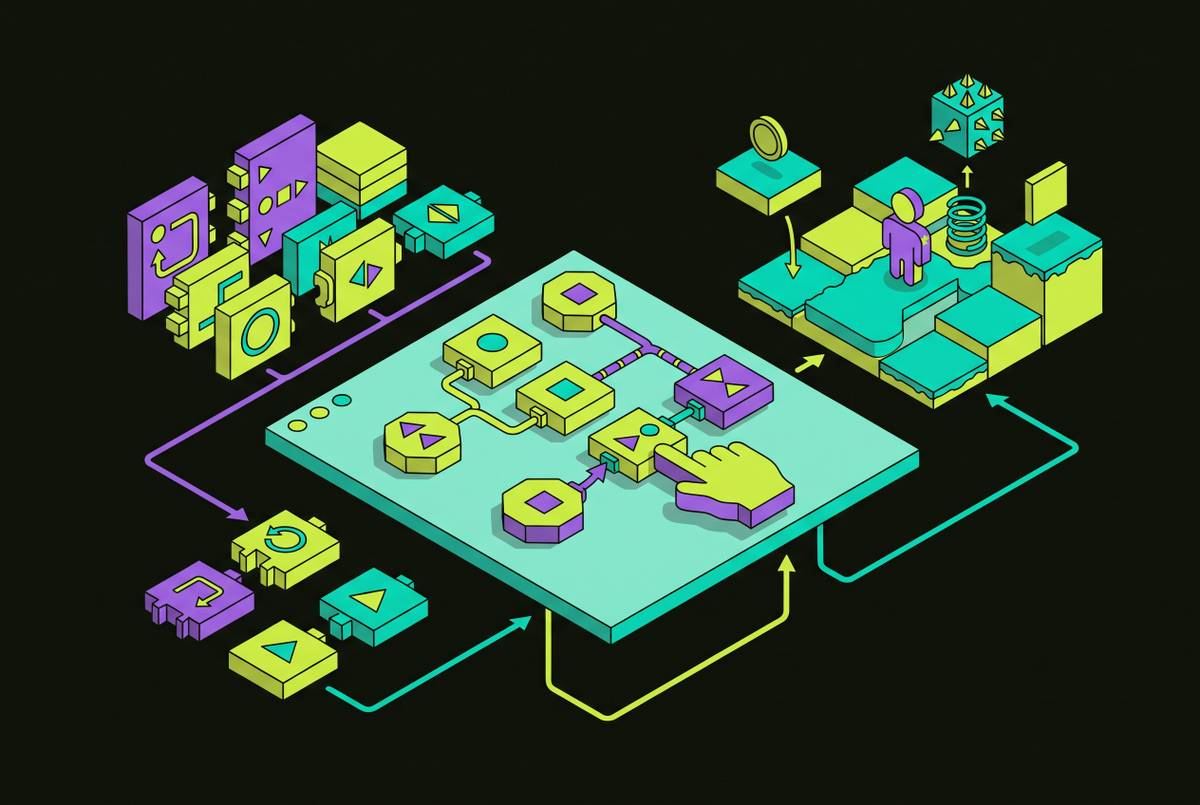
The practical workflow starts with a template close to the intended game. From there, the creator describes the core loop in plain language, tests the result and changes one mechanic at a time. This keeps the work tied to something playable rather than an expanding description of a future game. Each iteration gives the creator a concrete basis for the next instruction. The process is learnable because the unit of progress is a change that can be tried.
For this approach, the AI needs to operate inside the engine. The intended interaction is direct, with the creator describing a behavior and the tool building the scene, writing and attaching scripts, and setting up physics and input. The next step is to press play and judge the result. Copying code from a separate chat window and attaching it manually interrupts that feedback loop. It also puts more of the implementation burden back on the person the workflow is supposed to support.
Understanding scenes, nodes and the core loop still helps, even when the creator writes no code. That knowledge makes instructions clearer and makes errors easier to recognize. AI can accelerate prototyping, code scaffolding and asset generation, but it does not remove the need for design, tuning and polish. A working mechanic is not necessarily a satisfying one, and a playable build is not necessarily ready to sell.
How musicians handle the two remaining bottlenecks: visual assets and audio generation
Visual production is the most obvious gap for a musician building alone. A score cannot populate a level, and a working mechanic still needs a visual form appropriate to the game. Asset generation can reduce that burden enough to make completion more achievable. Meshy’s character generator describes a route to textured, rigged characters that are ready for export. That addresses a concrete production task, although generating individual assets does not by itself establish the visual coherence of a finished game.
Audio generation serves a different purpose for someone who already makes music. Rather than replacing the creator’s strongest skill, it can supply material for further production. Suno’s September 9, 2026 model replacement introduced the v6 family, built with Warner Music Group, BMG, and Believe. Its three variants are v6 for precise direction, v6-wild for less predictable material, and v6-mini as the fast free model. Studio’s stem separation and MIDI export allow generated ideas to move into a DAW, where the musician can develop a chord progression or melody line.
Commercial use requires a separate decision about rights. ElevenLabs Music and Stable Audio 3 are described as using licensed training data and permitting broad commercial use, but those permissions have boundaries. ElevenLabs Music self-serve plans do not cover film, TV, and Studio Games, which need Enterprise. Stability AI’s launch material states that Stable Audio 3.0 uses fully licensed data and that the Stability AI Community License permits ownership, distribution and commercialization of outputs. These terms apply specifically to the products described.
Austin Wintory’s concern about copyrighting AI-generated music belongs within this production discussion. His account of recent contracts includes declarations that his work was not AI-created. A hired composer who must meet a publisher’s requirements therefore has different choices to weigh from an author-developer who sells a game directly. The latter has more control over the production choice, but must still check whether the license permits the intended use.
Publishing a musician-made game: what the platform choices actually mean
Publication is where a playable project becomes a product that an audience can obtain. The route described here leads to a release on Steam and itch.io, beyond a demo that runs only in a tool’s browser environment. The distinction is practical ownership, export and distribution. A musician-author needs the result of production to remain usable beyond the system that helped create it.
One way to release a game is to test a build and get feedback on itch.io before a polished Steam launch. Another approach makes Steam the headline release and puts the game on itch.io the same day for the audience that prefers it. A direct store can then carry the original soundtrack, an art book and any build without copy protection. For a musician-author, the soundtrack is a natural extension of work already central to the project. It can become a third sales channel.
The notes describe Steam’s informal price-parity policy as creating a risk of reduced promotional support or delisting when a game sells more cheaply elsewhere. The recommended approach is to publish with a complete page, avoid weekends when more games release and consider the target audience’s timezone. These release decisions remain the creator’s responsibility even with faster code or asset generation.
The games: musician-authored titles that shipped in 2026 and what makes each worth playing
The supplied material lacks primary evidence for the title, release date, platform, price and creator’s role as a musician-author for a set of complete games released in 2026. Without that foundation, selecting the best would confuse evidence of composition with evidence of game authorship. No title can responsibly receive a recommendation here on the strength of these notes alone.
Yamaoka’s contribution to the argument is his design-first orientation. He prioritizes what the game needs when deciding what music to write. His interest in engines, middleware, interactive music systems and sound design also connects creative choices to technical possibilities. Those concerns explain why a composer could bring a distinctive perspective to full authorship. They do not establish a game that he independently authored and shipped in 2026, nor do they provide grounds for judging such a game’s playability.
Woodkid provides a different kind of evidence through procedural composition. Building a system that remakes songs according to harmonic theory puts the composer in direct control of musical behavior. That work makes the boundary between composition and systems design less rigid. It is valuable to study for that reason, without treating an audio engine as equivalent to a complete game. The stronger claim would require evidence of responsibility for the playable work as a whole.
Winifred Phillips’s January 2026 resource collection shows sustained engagement with the technical and creative infrastructure of game audio. Phillips describes the profession as a community that develops knowledge through conferences, discussion and shared practice. Her Grammy Award for Best Video Game Soundtrack in 2025 and her invitation to speak in the Congressional Auditorium of the Capitol Building in Washington D.C. establish recognition of that expertise. They do not establish a transition to releasing her own game.
Rachel Hardy’s account of the October 2026 composer interviews names Akira Yamaoka, Jon Everist, Niels Bye Nielsen, and Rachel Hardy. That establishes a group of composers active in the year’s professional discussion, but supplies no corresponding list of games they authored and released. Each proposed entry still needs a primary record, such as a store page or developer interview that confirms the facts.
What the musician-author wave means for anyone else who has always wanted to make a game
Deep expertise in one creative field can become a foundation for game authorship. Music is a strong example because emotional pacing and original audio are already valuable parts of the finished work. Visual art, writing and sound design offer other starting points within the same proposed workflow. The creator brings a point of view shaped by their work and uses AI to help with coding and assets they cannot make themselves. That is a more precise proposition than suggesting a tool supplies the whole act of creation.
The recommended route is to build inside an engine that preserves ownership and produces exportable, publishable games. A template gives the game its starting structure, and repeated playtesting lets the creator shape what has been generated into the design they want. Yamaoka’s advice to make something with other people, work on a real project and develop a personal voice remains relevant. AI assistance changes who or what performs parts of the execution. Completion still depends on sustained choices about what belongs in the game and how it should feel.
The decisive distinction is therefore between assistance that leads to an ownable release and assistance that stops at a proof of concept. The 2026 workflow makes the former more achievable for musicians without a programming background. The supplied evidence does not yet show which shipped titles best demonstrate that change.