Best Games Made Without Code in 2026
Games shipped with no-code tools prove what AI actually delivers.
The best games made without code in 2026 are defined by what survives beyond the first demo. The tool underneath them matters most, especially its support for an exportable, ownable game that can keep improving. Engine-backed AI makes that possible, but a credible account must distinguish shipped games from announced projects and agent-assisted development from a genuinely no-code workflow.
Why "no-code game" means something very different depending on the tool underneath it
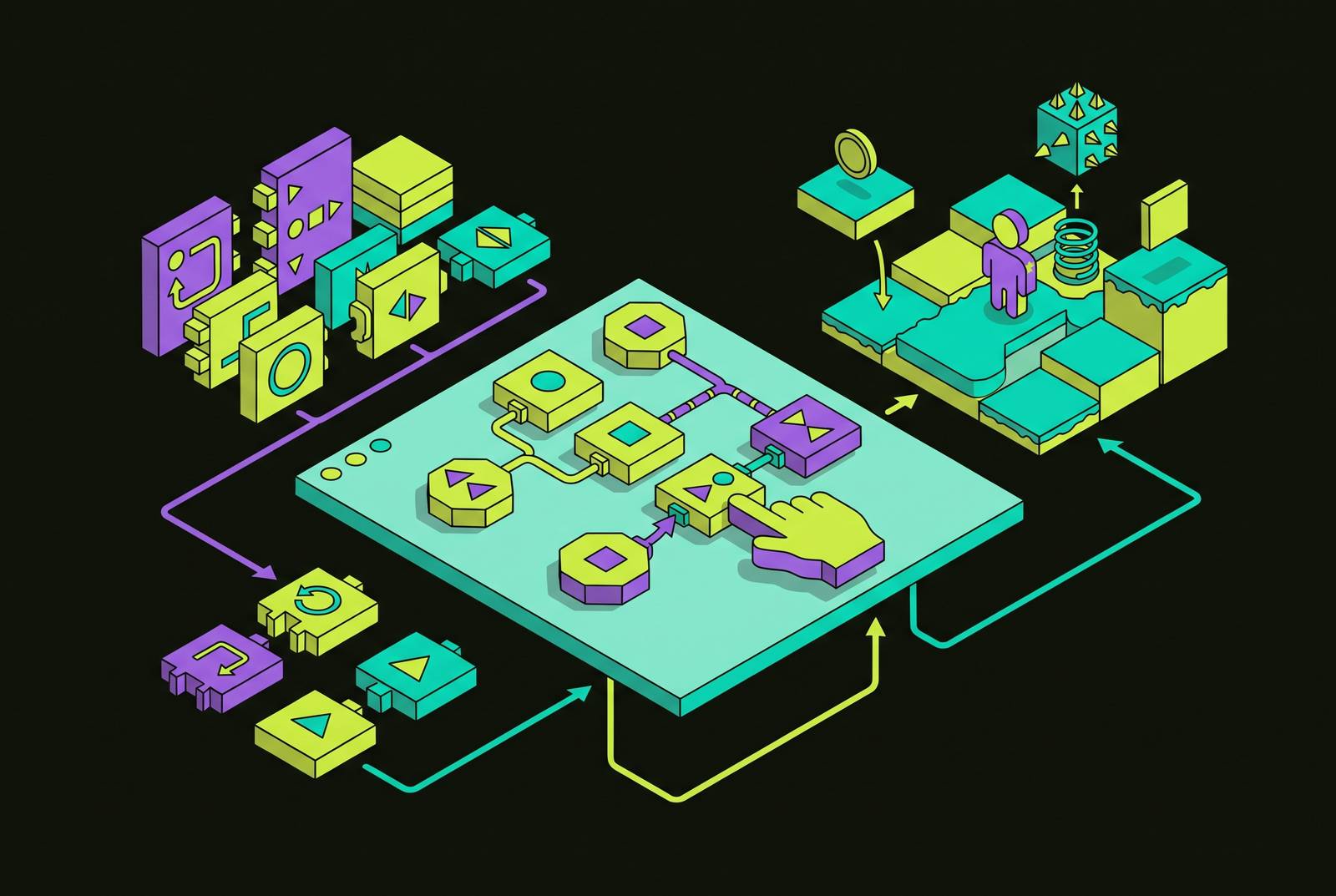
An ambitious description goes into a chat box, and a browser demo comes back with no usable export. That disappointment begins with a category mistake. “No-code” can describe a tool that hides code entirely, a visual system for building logic manually, or a real engine whose AI writes and edits code while the creator stays in conversation.
The first approach stops when a requested behavior exceeds what the tool can express. Visual event sheets offer more flexibility, but their logic still takes time to learn. The engine-backed approach changes where the boundary sits. Its underlying code remains available for the AI to revise, so the project’s scope depends on the engine.
The three checks that tell you whether a no-code tool can produce a real game
Three questions provide a practical diagnostic, beginning with where the tool stops being no-code. The first behavior that cannot be produced through conversation exposes the boundary of its conversational promise. A long feature list cannot settle that question. A tool may handle its advertised examples while requiring manual code edits for the particular behavior a project needs.
Second, check whether the creator can export and sell the result. Playability inside a hosted preview does not establish that. Export support and permission to commercialize the project are separate from the quality of its generated art or logic.
Some tools target contained 2D browser experiences, while broader 3D, multiplayer, and physics-driven projects need supporting infrastructure, including a scene tree, an export pipeline, and diagnostics the AI can read. These checks classify scope. A browser tool that passes none may still be appropriate for a thirty-second prototype sent to a friend, while offering too little infrastructure for a commercial project.
What the tool landscape actually looks like in 2026, sorted by how far you can go
The 2026 field broadly divides into quick browser generators and engine-backed environments where AI writes real code. The first group suits prototypes shared by link. The second supports projects that must remain editable through a longer production process. Between those categories, visual development tools show why “browser-based” and “unshippable” cannot be treated as synonyms.
Construct 3 runs entirely in the browser and uses visual event-sheet logic. Its publishing documentation lists exports for HTML5, Android, iOS, and desktop, with desktop and mobile export requiring a paid subscription. The creator still builds the logic manually. It therefore belongs in the visual no-code category.
Engine-backed conversational tools address a different requirement, which is keeping code available without requiring the creator to edit it directly. Their scope depends on the underlying engine. By contrast, pairing a code assistant with a conventional development project remains low-code or traditional development when the user writes and edits source. For a project intended for sale, the relevant distinction is therefore not the presence of AI alone, but whether conversational control, export rights, and the required game structure coexist.
What AI actually compresses in game development, and what it does not
AI accelerates building work more reliably than design judgment. Scene scaffolding, boilerplate code, asset batch-processing, test generation, and localization are all bounded tasks with outputs that can be reviewed. An agent given a translation table can produce consistent, game-context-aware localization in six languages in minutes.
Althera Games provides a concrete example of this division. The small Turkish indie studio used agents for scaffolding, test generation, localization, and scripting. With those uses, agents help with the work while humans keep their role as authors. They also do not, by themselves, establish that the studio’s projects required no manual coding. Agent-assisted development and conversational no-code development overlap, but they are not interchangeable claims.
People still need to work on game feel, economy balance, narrative coherence, and level design. These phases often dominate the actual timeline. The practical rule is to give agents well-scoped, verifiable tasks and keep a human reviewing every change, rather than allowing unsupervised edits across many files. This is where the underlying tool becomes consequential again. An engine-backed agent that can read the running game’s diagnostics can correct implementation errors during iteration, while a frozen browser demo cannot support that same process.
The specialist asset stack that fills the gaps no single tool covers
Most serious no-code and low-code indie pipelines in 2026 combine an engine or builder with three to five specialist tools. Each tool works on a type of asset or a stage of making the game. This division explains why the engine’s AI is rarely the whole pipeline, even when it handles implementation. Asset generation remains a separate job with its own constraints.
For 3D assets, Tripo works especially well for image-to-3D reconstruction and is often faster than Meshy, while another 3D tool is better at making single objects with more detail. To keep 2D art in the same style, Scenario lets creators train it on their own art style. Its FAQ describes training time as dependent on the images and settings, so style preparation and art direction remain part of the work.
ElevenLabs makes voices and is used more and more for sound effects, while a music-generation tool makes tracks from prompts for uses that include indie soundtracks and loops. Licensing can restrict an otherwise usable asset. ElevenLabs’ free tier is non-commercial, and its music license excludes larger monetized games below the full Enterprise Music tier, including Enterprise Music Lite, though qualifying indie games are covered under its revenue thresholds. Suno has a free tier with usage limits, which does not alone establish commercial permission. The practical requirement is to read asset terms before release, especially where free tiers impose attribution or non-commercial restrictions.
Where no-code games have actually shipped in 2026 and what they look like
Release status is the first dividing line. Potion Rise Simulator is an Althera project in development. Its Steam page names Althera Studio as developer and gives the release date as “Coming soon.” A storefront presence establishes a destination, but it does not establish that players can obtain a completed release.
NightRecord: Thin Walls is identified as a shipped Althera title, with Steam as its named storefront. The studio’s press kit calls it its second project, while the Steam page lists Althera Studio as developer and publisher. The available detail stops short of describing mechanics. It also leaves unclear how much of this particular game was created conversationally and how much through manual development. The title provides evidence of a studio reaching publication, with insufficient detail for a feature-by-feature assessment of a wholly no-code game.
That limitation affects what these examples can prove. Althera’s agent-assisted workflow shows that AI can help make serious indie games, while Potion Rise Simulator shows that progress on a game can still leave it short of a completed release. Neither title’s name tells whether it has 2D, 3D, multiplayer, or physics-driven play. In general, browser-tier projects tend to be contained 2D games, while engine-backed projects can do more. Applying that distinction to an individual game, however, requires details that are not established here.
How game jams became the proving ground for no-code AI games — and where they draw the line
Game jams give developers without an existing audience a route to discovery on itch.io. They also let the public see and judge games made in a short time. For no-code AI games, that makes them a venue where playable submissions can be completed and judged publicly.
GMTK Game Jam 2026, held July 22–26, 2026, required participants not to use generative AI for art or audio assets. Its organizers asked participants to “just make the game yourself” and acknowledged that art and audio were the areas they could actively police. That restriction applies specifically to this jam. Other jams embrace AI-assisted participation, although the available examples do not name an accepting event or establish its rules. The disagreement concerns authorship, craft, and the purpose of the competition rather than whether an AI-assisted submission can be playable.
For creators navigating an asset ban, the relevant distinction is between a prototype and the submitted game. AI-generated placeholders can be replaced with handcrafted or licensed assets before submission where the rules govern only submitted assets. This is ordinary prototyping subject to the jam’s rules. A broader ban on AI assistance may still rule out that use of placeholders. The practical approach is to treat each jam’s wording as the governing requirement, rather than assume either blanket acceptance or blanket exclusion.
Publishing a no-code game in 2026: what the platforms require and how AI disclosure works
Itch.io and Steam both allow AI-generated assets in 2026, with disclosure requirements that form part of publication. Neither platform treats AI use as an automatic bar. For indie developers, the established path is to begin on itch.io and expand to Steam rather than treat the platforms as mutually exclusive choices.
Steam requires AI content disclosure during submission. Valve updated its form in January 2026 to focus on content that “ships with your game, and is consumed by players.” AI-powered development tools used for workflow efficiency, including code assistants and debugging software, are explicitly outside that scope. A game made with an assistant therefore needs a different disclosure assessment from a game containing generated art, audio, or other content players consume.
Asset permissions are a separate release requirement. Meshy free assets have a CC BY 4.0 attribution requirement, while ElevenLabs’ non-commercial free tier and music-license thresholds constrain commercial use. Those terms apply when the assets are generated and when the game goes on sale, so being able to export the project does not by itself give the creator the right to sell everything in it. Publication requires the game, its asset rights, and its disclosures to align.
By 2026, the tools, storefronts, and disclosure rules provide a workable route for a no-code game to reach Steam. There is no structural technical or regulatory prohibition. The remaining barrier is creative and logistical, including finishing the design, tuning the experience, clearing the assets, and completing submission. An engine and an agent can support that work, but the creator still has to finish the game.