Best Indie Games of 2026 Made With AI Tools
AI tools now let solo developers ship games that once required five-person teams.
Sources describe the indie scene in 2026 as a landmark year, with Steam and itch.io overflowing with titles, new VR and AR marketplaces opening up, and crowdfunding evolving into hybrid publishing. None of that happened because indie developers got more talented overnight. It happened because the tooling under them changed.
By 2025, 87 percent of game developers were already using AI agents somewhere in their workflow, a number that puts this well past the experimental phase and into standard practice. That's mainstream behavior across the whole field, well beyond a subculture of early adopters tinkering on the side. That's most of the field.
What that shift buys a solo developer is concrete: someone working alone in 2026 can put out a game that would have needed a five-person team as recently as two years back. Developer surveys cited this year put the production time savings at around 70 percent, with asset costs cut by roughly half, figures reflecting actual hours off developers' calendars rather than marketing copy. That math changes who gets to finish a game. The bottleneck used to be headcount and budget. Now it's whether a person can hold a scope steady, keep their taste sharp, and actually see the project through to the end. The six games below are what that looks like when it works.
Six indie games that defined 2026 for small teams and solo creators
Annapurna Interactive's Mixtape, out May 7, 2026, is a narrative adventure built around one last night three friends spend together before their paths split for good. Players relive that night through skateboarding sections, music-driven bits, and a string of mini-games and vignettes, running on PC, PlayStation 5, Xbox Series X|S, and Nintendo Switch 2. It's a small, specific story told through a licensed soundtrack and an atmosphere that sits somewhere between relaxing and quietly heavy.
New characters, new cards, more enemies to figure out, and the same core promise as the first game: no two runs play the same, because the card synergies stack differently every time, and this keeps the entry point simple while the strategy stays deep.
Driffle published three titles on the same day, July 24, 2026, each aimed at a different kind of player. Mewgenics mixes turn-based strategy with life simulation: players breed cats with distinct abilities and personality quirks, then send them into tactical matchups, landing on PC with a tone that's equal parts funny and strategic. Meccha Chameleon is a 3D platformer built for multiplayer hide-and-seek, where characters paint themselves to blend into the environment and dodge the seekers, running across PC, Nintendo Switch, PlayStation 5, and Xbox Series X|S with movement and level design built to be friendly to a wide age range. Paralives rounds out the trio as a life simulation on PC, built around deep customization and construction tools that hand the player the job of deciding what a normal life even looks like.
Then there's MindCanvas, and this one matters for a different reason. Built entirely by one person, Aria Chen, working out of Singapore, it launched in June 2026 for PC and VR headsets as an experimental puzzle adventure. Inside it, AI reads the player's input directly: brushstrokes carrying joy or sorrow reshape the puzzles and bend where the story goes.
Echoes of the Last Forest closes the list, made by GreenPixel Studios, a five-person team working out of Brazil. Released in March 2026 for PC, cloud XR, and mobile, it's a narrative survival sim set in a forest that generates itself procedurally, where every choice a player makes chips away at, or protects, a shrinking ecosystem. The game is available on PC (Early Access). It stands as the clearest confirmed example from sources of AI-as-mechanic in a 2026 indie title, also notable as a solo-creator VR release.
Lining these six up shows a pattern: small teams, often just one or two people, shipping games with genuinely original mechanics and reaching across several platforms at once. None of them look like a scaled-down version of something a bigger studio already made. That raises the obvious question: how can a solo developer in 2026 realistically ship a game that would have required a five-person team two years ago? Slay the Spire 2 (Mega Crit, published 2026-03-05). The genre is classified as Roguelike Deck-Building RPG.
Points where AI hands work back to you in a real indie pipeline
Game development breaks down into distinct jobs, concept work, coding, art, audio, dialogue, and shipping, and AI doesn't collapse that pipeline into one step. It fills specific gaps inside it, which is a much less flashy claim than "AI makes games now," but it's the accurate one.
Start at the top. Before a line of code gets written, a chat model like ChatGPT or Claude works as a free sounding board, useful for pressure-testing scope, naming systems, and cutting the features that were never going to survive a solo build anyway. Then comes code, scenes, and runtime logic, which eat the most time on any real project. This is the highest-leverage job, because it's the slowest part of solo development, and consolidating it into one AI-native tool removes the most integration work.
Art tells a more mixed story. On the 2D side, generators are fast and thorough, covering sprites, tilesets, and UI elements without much fuss, though holding one consistent visual style across an entire game is still where they struggle. Three D work follows a similar pattern: generated props and environment pieces make solid starting points, but they usually still need retopology, clean UVs, and rigging done by hand before they're actually ready to ship. Audio generation fills out music beds and sound effects, and NPC tools can produce dialogue barks, branching lines, and rough behavior scaffolding. None of it, though, gets a developer all the way to done.
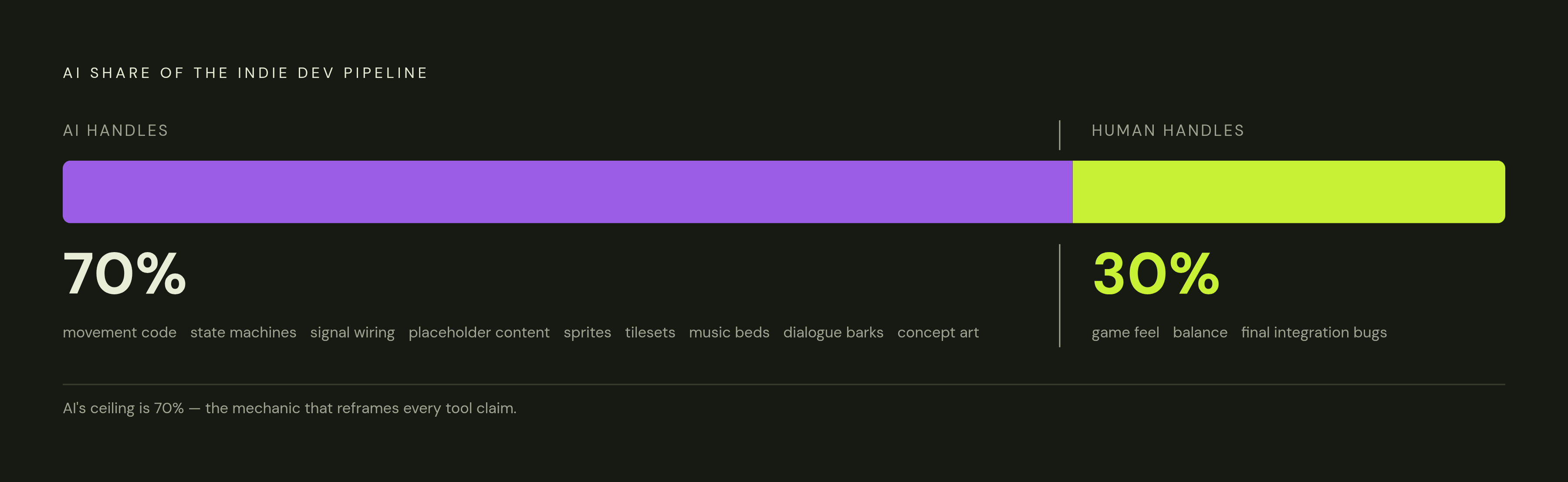
AI carries roughly the first 70 percent of the work, the movement code, the state machines, the signal wiring, and the placeholder content, and it gets noticeably weaker past that point, right where game feel, balance, and the last stretch of integration bugs live. The last thirty percent is still a human job. The practical move, then, is to start from a template close to the target genre, get the core loop playable, hit run, and iterate one mechanic at a time, because asking for an entire game in a single prompt is the fastest way to end up with a project that's broken in ways nobody can trace.
There's a budget trap hiding in all this too. Most solo developers need far fewer tools than they think: one AI-native engine to handle code and scenes, two or three asset generators, and a free chat model for planning. Stacking ten different subscriptions on top of that is where a lot of indie budgets quietly bleed out.
The tool landscape for indie game creation in 2026
No-code, AI-native platforms are one end of the spectrum. MakeGamesWithAI works by letting a developer describe a concept in plain language, after which the AI generates a functional game complete with mechanics, assets, and objectives, no code required. After that first generation, a chat-based interface takes over for iteration, adjusting character speed, reshaping levels, or bolting on new features through plain text commands. It ships with a library of more than 100 professional gaming assets, plus instant publishing and global leaderboards baked in. It's built for beginners, fast prototyping, game jams, and anyone with a creative idea but no coding background, though it offers less granular control than writing code by hand, works best inside the genres it's tuned for, and the output stays browser-hosted.
Tools built this way support full 3D, multiplayer, and Steam export, with no watermark, no revenue share, and no restriction on commercial use, and what comes out the other end is a real, usable project file rather than a locked demo. They run as desktop apps on macOS and Windows, free to start with paid tiers for heavier AI use, and they're built to work alongside the wider open-source engine ecosystem, tapping into existing plugins, tutorials, and community knowledge. The fit here is solo developers and small teams aiming to ship a real 2D or 3D game to Steam or mobile, though it's worth being upfront that this requires a download, the community around it is younger than the older engines, and anyone who just wants a five-minute browser demo will move faster with a browser-based generator instead.
Traditional engines haven't stood still either, and AI has folded into them rather than replaced them. Unity remains an industry mainstay, deploying across more than 20 platforms spanning PC, consoles, and mobile, with an asset store stocked full of pre-made models, scripts, audio, and tools that speed development. It suits ambitious 2D or 3D projects, cross-platform launches, and anyone who wants to learn an engine that shows up across the whole industry.
Unreal Engine 5 leans hard into visual fidelity, with Lumen handling dynamic global illumination and Nanite managing virtualized micropolygon geometry, putting AAA-level visual features within reach of indie creators. Pricing runs on a royalty model, a percentage of revenue that only kicks in after the first million dollars earned. It's the right fit for high-fidelity 3D work, teams that put graphics first, and developers who'd rather build with visual scripting than raw code, though it does demand serious system resources and can be more than a simpler or 2D project actually needs.
An open-source engine option remains completely free, with no royalties and no subscription fees attached, and it stays lightweight enough to make rapid prototyping genuinely fast. For solo developers specifically, it's frequently the recommended pick, precisely because it's light, open, and quick to get moving in. A strong AI tooling ecosystem has grown up around it too, which the next section covers in full. A separate 2D-focused engine also holds its ground as a credible alternative for developers prioritizing fast development cycles on two-dimensional projects.
Beyond full engines, a layer of assistant tools and specialist generators fills in around the edges. GitHub Copilot, running inside an existing engine setup, works best for developers who already know their engine and just want autocomplete and inline code edits rather than a tool that assumes no prior knowledge. Cursor serves code-heavy projects well, and pairs particularly well with GDScript work when it's connected to a Godot MCP server. Past that, a set of specialist tools each own one job in the pipeline: Inworld AI handles NPC dialogue and narrative depth, Convai builds conversational NPCs suited to VR and 3D work, Scenario and Leonardo.ai both generate art for asset pipelines and concept work, Meshy turns text or image prompts into 3D models, Suno and Udio generate music, and ElevenLabs covers voice and sound effects. For quick, playable prototypes built entirely in-browser, there's also a generator built specifically for game jams and fast demos, browser-only, with no path to Steam or desktop export.
None of this adds up to one best tool for every job. It adds up to the same lesson from the pipeline breakdown: match the tool to the job in front of you, and the real efficiency gain comes from cutting down how often a developer has to context-switch between systems, not from chasing whichever tool claims to do everything. The AI agent operates the live editor: it creates scenes, adds and configures nodes, writes scripts to disk, runs the game, reads runtime errors, and self-corrects.
AI coding assistants and Godot: community tools and workflow
The open-source engine mentioned above has become a live testbed for how AI coding assistants actually behave once they're inside a real, working codebase rather than a demo. GitHub Copilot slots in as an upgrade layer for developers who already know their way around the editor, offering autocomplete and inline suggestions rather than trying to build understanding of the engine from scratch. That distinction matters. It assumes the developer already knows what a scene tree is and how signals connect nodes together, and it works fastest for people who clear that bar already.
Cursor is an AI IDE best suited to code-heavy projects, and it's a strong external option for GDScript work when paired with a Godot MCP server. That pairing lets the AI reach past plain autocomplete into something closer to actual engine awareness, reading project structure and responding to it directly, rather than guessing at syntax in a vacuum.
Compatibility with this engine's plugin and tutorial ecosystem means a developer isn't boxed into an isolated toolchain. Plugins, tutorials, and community knowledge transfer within the compatible Godot ecosystem.
No assistant, however it's wired into the editor, gets around the same 70 percent ceiling covered earlier, and that's the unglamorous truth. Movement, state machines, signal wiring, and placeholder content come fast. Game feel, balance, and the last mile of integration bugs still land on the developer's desk. That's simply a description of where these tools currently stand. It's simply where the pipeline currently draws its line, and every indie developer shipping in 2026 is building around that line, not past it.