Game Engines With Zero Revenue Share so Hobbyists Can Actually Profit on Steam
Godot and Bevy let indie developers keep all Steam revenue without paying the engine a royalty cut.
Zero-revenue-share engines let hobbyists sell on Steam without giving the engine maker a percentage of sales, though Steam still takes its own cut. Godot and Bevy provide that freedom through permissive open-source licenses. For non-programmers, AI-native engines offer a different route, but the decisive requirements are game ownership, unrestricted export, commercial publishing rights, and no revenue share (not simply the ability to generate a game).
Why the engine you pick decides how much of your Steam revenue you actually keep
A hobbyist can finish a game, start collecting Steam sales, and discover that the development software now requires payment. That payment may be a paid seat activated by revenue or funding, or a royalty on sales above a threshold. The distinction changes the economics of a successful launch. A seat fee is a cost of using the software, while a royalty gives the engine maker a claim on qualifying revenue. Neither is visible in the price of a free download.
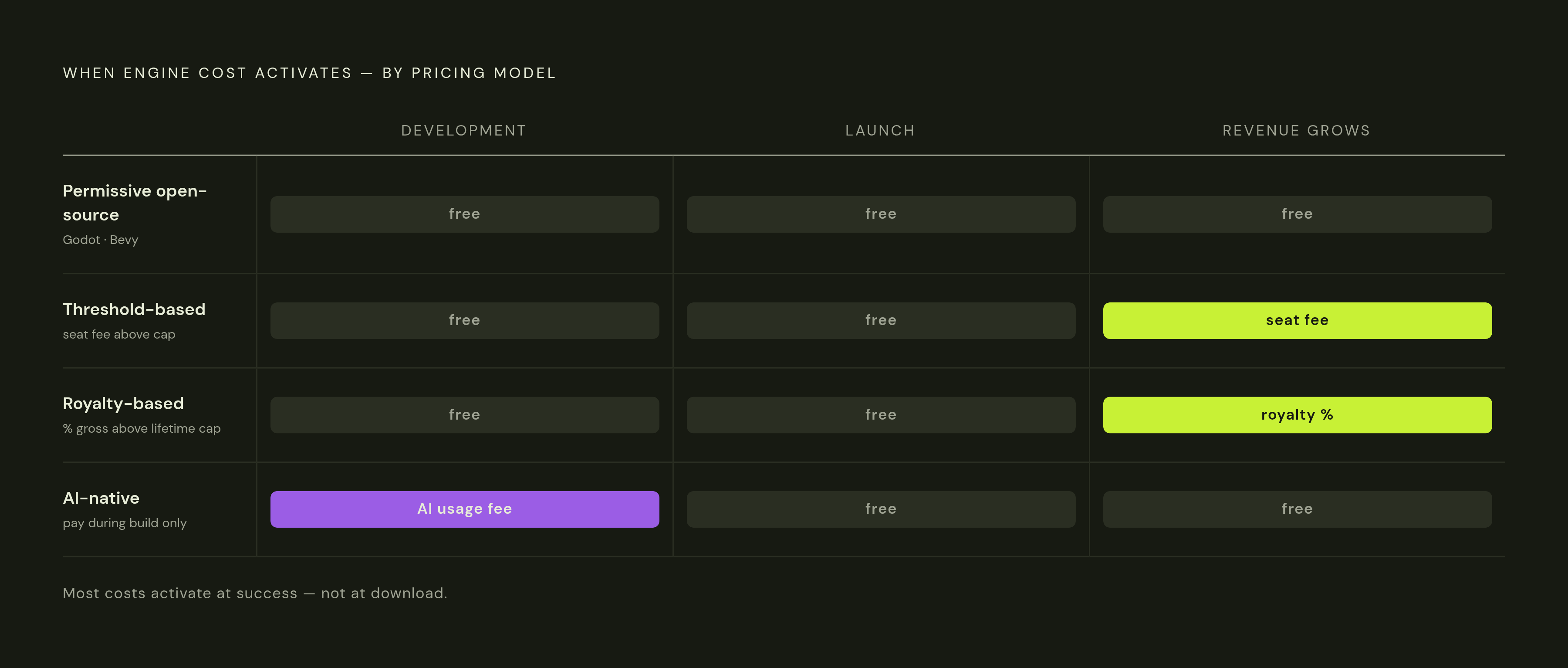
The traditional landscape has three broad pricing shapes. A permissive open-source engine can have no royalties, no revenue threshold, and no paid seats. A threshold-based engine can be free for a small developer but require a subscription once revenue or funding rises far enough. A royalty-based engine can allow free development and publishing, then take a percentage above a lifetime revenue cap. AI-native tools add a different arrangement, in which the developer pays for the work of building and retains sales revenue free of an engine share.
These models of “free” place costs at different points in the project, and success can activate obligations that were irrelevant during development. For a hobbyist choosing an engine, the central financial question is therefore not whether starting costs anything. It is whether the terms change when the game earns money.
What Steam itself takes before the engine takes anything
Steam takes its platform share before the developer gets to keep the money from sales. Its revenue split starts at a flat rate and steps down at two lifetime revenue marks. The vast majority of indie games never reach those marks, so most hobbyists remain on the full rate. An engine royalty is a separate claim in addition to Steam’s cut.
A royalty based on gross revenue should not be read as a percentage of whatever remains after Steam’s share. The storefront and engine use their respective terms to determine what is due. Zero engine royalties remove one deduction while leaving other publishing costs in place.
Itch.io lets developers set a small or zero platform fee, so they keep almost all the revenue apart from payment processing. That makes it a natural proving ground before committing to Steam’s upfront cost. It does not change an engine license, however. Wherever a game is sold, its publishing rights and the engine’s terms still need to allow it to be sold.
The genuine zero-royalty engines and what their licenses actually permit
Godot provides the benchmark for a genuinely zero-revenue-share engine. Its MIT license permits commercial use, modification, and redistribution, with no royalties, revenue cap, seat fees, or mandatory splash screen. This permission to build and sell keeps the same financial terms regardless of commercial success.
Godot supports both 2D and 3D and exports to Windows, macOS, Linux, mobile, and web, with direct Steam export. Its web support has a specific language limitation. C# is not supported for web exports, while GDScript and GDExtension can be used. Export support therefore needs to be understood at the project level.
Bevy gives developers much the same freedom from fees through its MIT and Apache 2.0 dual licensing. Bevy’s official site describes its terms as “No contracts, No license fees, No sales cuts.” It is fully open source, with no royalty or revenue threshold. Bevy is based on a systems programming language and is code-first, with no traditional GUI editor yet, so it suits developers comfortable writing code rather than hobbyists seeking the easiest technical entry point.
Cocos Creator 3.8.9, dated August 2026, is the final 3.x release, while COCOS 4 is the current open line. After the January 2026 change, older accounts of the license can no longer be relied on when choosing the current line. The relevant distinction remains the actual license for the version being used, rather than a general description of the engine as free.
Permissive licensing and conditional free access answer different questions. The former grants broad rights without linking an engine bill to sales, while the latter grants access within defined limits. Open-source freedom also does not imply a no-code workflow. Godot and Bevy can both eliminate royalties while asking very different levels of technical skill from their users.
Engines that look free but carry a hidden cost at the moment of success
A threshold-based free tier can be a reasonable choice for a hobbyist whose revenue and funding remain below its limit. But once revenue and funding together cross the threshold, the developer needs a paid seat. That payment is for the use of the development software. It is not simply a small charge on the portion of sales above the threshold, so a developer cannot budget for it as though it were an incremental royalty.
For most hobbyists, that threshold may seem far off while they are making the game. A hit changes the calculation. Funding can also count toward eligibility where the terms combine it with revenue. Sales alone do not describe the developer’s position. The important distinction is between being free under present circumstances and having no revenue-linked condition at all. A license can offer the first without offering the second.
A royalty model works differently because its trigger is typically a lifetime revenue cap per product. The developer can download the engine and ship without an initial royalty bill, then owe a percentage of gross revenue above that cap. Most indie games never reach it. For a breakout game, however, the royalty applies to qualifying revenue above the threshold rather than disappearing because development began on a free basis.
Neither arrangement is inherently a poor bargain. A developer may have good reason to pay a fee later for tools that fit the game, especially if the game needs demanding 3D work. The financial requirement is to understand the exchange before committing the project. “Free to ship” and “zero revenue share” describe different promises, even when both produce the same bill at launch.
Why Godot has become the default zero-royalty engine for hobbyists shipping on Steam
W4 Games’ announcement, citing SteamDB, says that the number of Godot games published on Steam grew year on year in both 2024 and 2025. That evidence of publishing momentum connects the engine’s appeal to actual releases, while leaving its suitability for individual projects open. Hobbyists considering Steam are looking at an established commercial path.
Brotato, Dome Keeper, and Cassette Beasts give that path concrete examples. Their significance here is that Godot has supported shipped indie games, rather than that any one title predicts another developer’s outcome. Its native 2D pipeline also fits the size of game many hobbyists are likely to make for their first paid release. The 2D workflow was built specifically for 2D. That alignment is a practical reason to choose it beyond avoiding an engine bill.
GDScript adds another part of the explanation. It resembles a general-purpose scripting language, is designed for game development, and is readable enough for a hobbyist while remaining capable enough for production. It still requires programming. A beginner willing to learn scripting and a creator who wants to avoid coding entirely thus have different choices, even if both want the same ownership and royalty terms.
For a visually ambitious 3D first game, Godot offers licensing freedom while its 3D tooling is still catching up to proprietary alternatives. Its momentum should not obscure that limitation.
Where AI-native engines fit the hobbyist’s zero-royalty picture
AI-native engines address the gap between wanting to own a commercial game and knowing how to program one. Their defining workflow places an AI agent inside the engine to create scenes, write scripts, and generate assets. The agent is not simply a separate assistant producing text. For a non-programmer, this makes the development workflow itself part of the engine choice, with skill requirements considered at that stage.
AI-native tools can be free to start through a trial or credit allowance, then charge for heavier use because the underlying AI work has a cost. The developer pays for building the game. That can fit a zero-revenue-share goal without being free development, just as a tool subscription and a claim on future sales are different obligations.
For non-coders asking how to make and ship a Steam game, the useful answer is a set of publishing requirements. An AI-native engine must let the developer own the game, export it freely, and sell it without owing a revenue share. Steam, itch.io, and mobile publishing are places to release games made this way, but the chosen tool and plan must allow those exports. A free starting allowance alone does not give the developer those rights.
This creates a clear comparison with the traditional options. Godot combines permissive licensing with a scripting workflow, while Bevy offers similar financial freedom through code-first development in a systems programming language. AI-native engines instead aim to remove the need for coding skill while preserving ownership and commercial export. No named AI-native vendor can be ranked on those criteria without specific license and export terms. The category belongs in the shortlist, but its label is not sufficient evidence of suitability.
How to map a launch path from first build to Steam listing without a royalty surprise
The practical decision sequence begins before the first build. A hobbyist should establish whether the engine license is MIT or equivalently permissive, whether any revenue or funding threshold can activate a payment, and whether Steam export is native or well documented. For an AI-native tool, the same decision also requires explicit ownership and commercial export rights. Can this project become a game for sale without changing its engine-related financial obligations?
The next decision concerns the workflow the developer can actually use. A code-first engine may provide complete financial freedom but demand skills the creator does not have. A scripting-based engine may fit if learning to program is part of the project, while an AI-native engine may suit a creator who wants to avoid writing code. The license and workflow must both fit. Solving only one leaves either the publishing economics or the build process unresolved.
AI tools can fill gaps in 2D art, 3D models, music, and sound effects, but the engine’s license does not grant rights to everything imported into it. Meshy AI, Leonardo AI, Suno, and ElevenLabs allow commercial use on paid plans. Their current terms should be checked before generated assets enter a released game.
The storefront decision then sets the launch schedule. Itch.io can provide a proving ground before the Steam commitment, while Steam Direct requires an upfront listing fee that is recoupable once the game reaches a set threshold in adjusted gross revenue. Steam’s mandatory 30-day waiting period after payment must be included in the timeline. Payment is therefore a scheduling decision as well as a cost.
The final check is whether any engine-related claim on sales remains. With the correct zero-royalty license, commercial asset permissions, and an export path that supports release, the developer can separate platform deductions from development expenses. Steam takes its cut, payment processing still applies, and the engine takes no share. The game is shipped, and the remaining revenue belongs to its creator.