How AI-Native Game Engines Are Changing Indie Development
Indie developers gain speed when AI understands their project context, not just individual tasks.
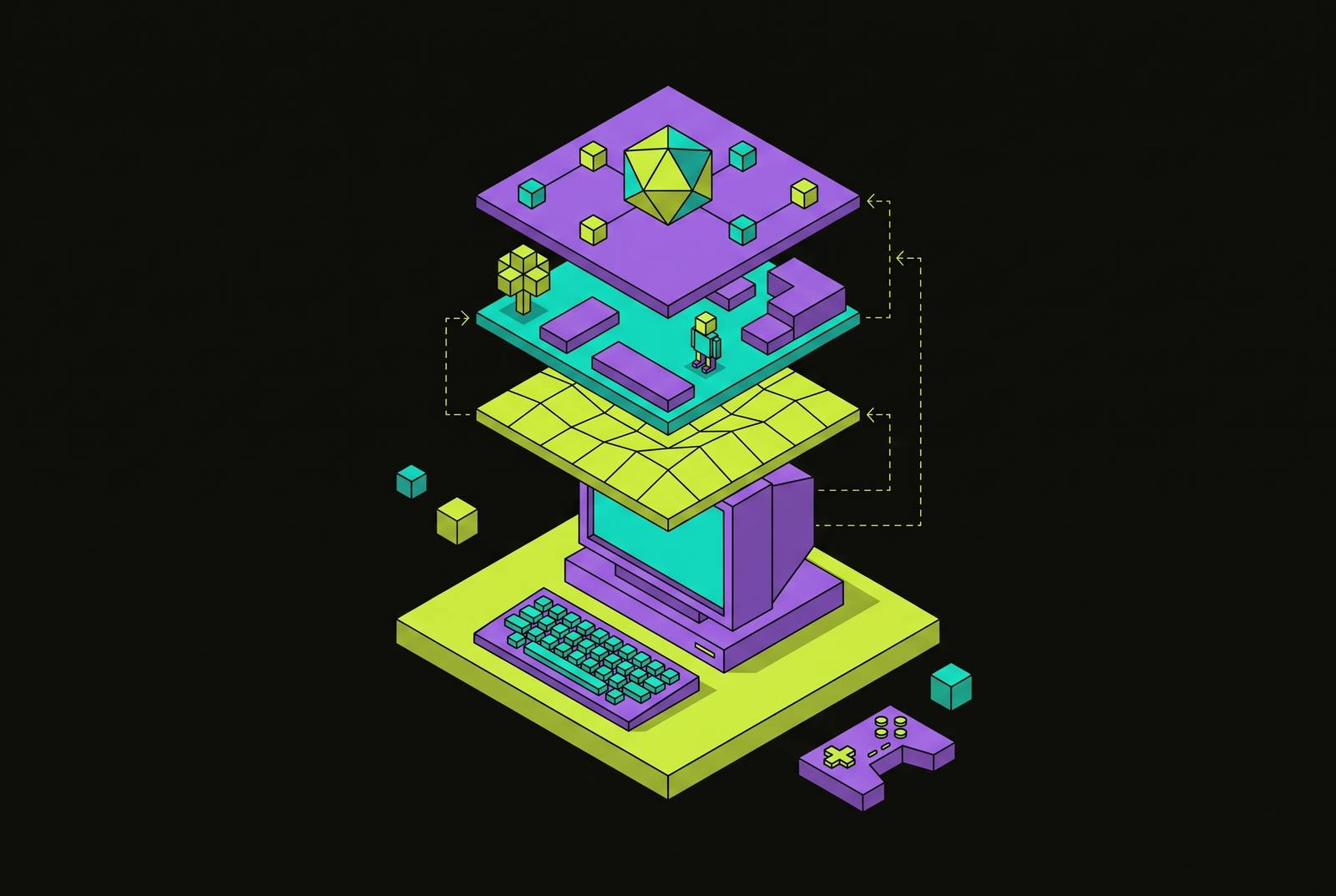
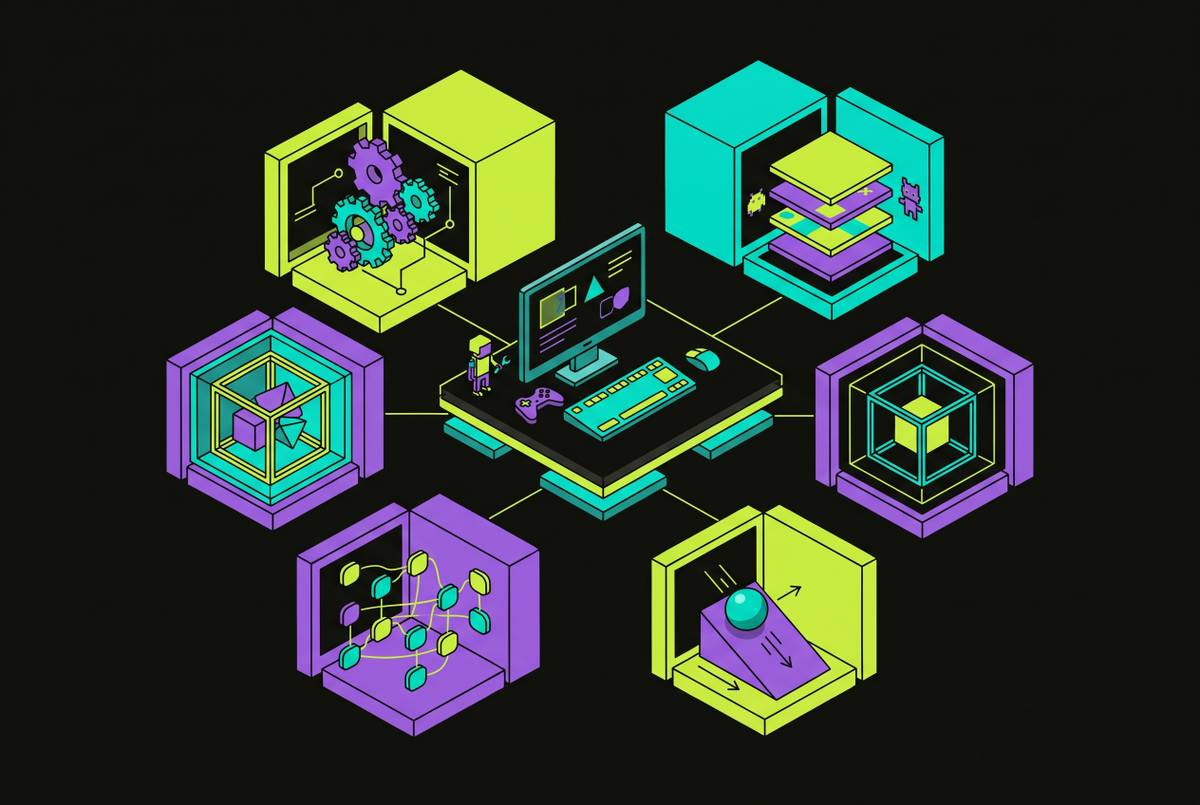
AI-native game engines change how indie developers work by bringing logic, scene-building, and asset integration into one workflow. The gain is less integration work and faster generation. For developers seeking code, art, and audio in one monthly plan, built-in AI is only part of the answer. Support for a complete production pipeline depends on what the subscription covers, how generation is metered, and whether the engine has native export.
Why the gap between "AI-assisted" and "AI-native" matters more than the tools themselves
A developer types “make the enemies faster” into two different tools. In an AI-assisted setup, the request requires an explanation of which nodes represent enemies and which property controls their speed. In an AI-native setup, the engine already knows those nodes, their current values, and the property to change. The words are identical, but the work differs. One tool needs the developer to reconstruct context, while the other acts within context it already holds.
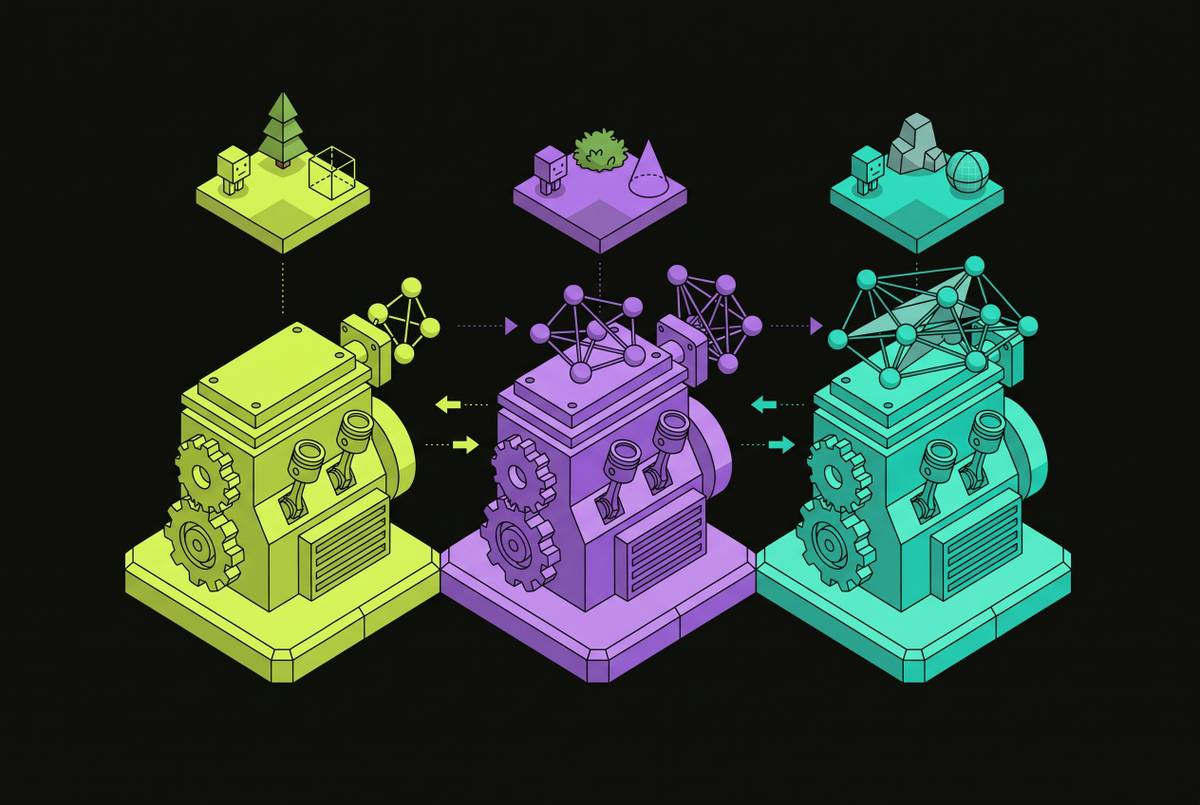
That difference makes engine choice a structural decision. An AI-assisted engine retains the traditional editor as its main interface and uses AI for individual tasks, including writing a script or generating a texture. The developer remains the integration layer between those outputs and the project. An AI-native engine instead places the agent at the center, with mechanics derived from intent through conversation.
The distinction is therefore not whether an engine offers generation. Both approaches can help produce individual parts of a game. Adding intelligence after mechanics leaves the developer to connect more of the parts, while building around the agent makes more of that work the engine’s job.
What "AI as a first-class system" actually means inside an engine
Persistent context is the first defining property of an AI-native engine. The AI tracks the scene tree, node names, and current property values across the conversation. It knows what the developer built five minutes ago. This continuity allows a request to refer to the existing project without restating its structure. Without it, conversation becomes another way to repeatedly document the same work.
A request such as “add a player character with a camera that follows it” creates nodes, wires up input, and configures the scene. It does not stop at a code snippet. The AI manipulates the engine through conversation in the way a developer would through the editor.
A character description produces a 3D model with textures and materials already imported and configured as an engine asset. Moving from “I want a robot enemy” to a robot enemy in the scene becomes one conversation. Persistent context, scene-building, and asset integration must work together for their productivity gains to compound, because each removes a different category of handoff.
A tool that produces a web page running a game can deliver a useful, shareable demo. That is a different kind of output. Without a scene tree, an asset pipeline, and native export, the generated page is not an engine project that can grow into a native release. Better generation alone cannot add those missing parts of the engine.
How these architectural properties change what a solo developer can realistically finish
For a solo developer, integration work consumes time that cannot be handed to another specialist. Code is the slowest part of indie development, and a code-only assistant still leaves its snippets to be connected to the project. Generating a script does not finish that work. An engine that can see both the scene tree and debugger output closes more of the loop between implementation and correction. That is especially consequential when a broken integration can cost a developer a day.
Consolidation also reduces the context-switching required to keep separate outputs aligned. There are still tasks to do, but fewer of them start with explaining the project again. Genre templates deepen this advantage by providing context. They give the AI a framework for inventory systems, dialogue trees, and appropriate combat options. The design-to-prototype gap narrows because the conversation begins with more of the game’s structure already understood.
A developer builds one mechanic, runs it, confirms that it works, and then adds the next. Each addition has a clear point of evaluation. Asking for an entire game at once instead risks producing a broken project without a clear point of failure. The practical gain comes from shortening these build-and-test cycles.
Asset generation shifts another part of the daily workload from creation to curation. Meshy and Tripo can produce textured models in minutes, making selection and refinement faster than starting from nothing. Generated art can drift across a full game, and players notice the inconsistency. A realistic solo pipeline therefore uses AI for the bulk of production while reserving human judgment for the pieces that define the game’s signature style.
The asset generation stack an indie developer actually needs in 2026
No single tool covers every asset category, but the complementary stack is narrow enough for one developer to manage. Its shape follows production stages rather than a ranking of supposedly interchangeable products. A model generator cannot make the audio a game needs. The useful comparison is what each tool contributes, what preparation its output still needs, and whether the engine absorbs that output directly. Those gaps determine how close the overall workflow comes to a complete production pipeline.
For 3D work, Meshy and Tripo are production-adjacent choices that supply a fast base. Generated meshes often still need retopology, clean UVs, and rigging before they are production-ready. The distinction is important when estimating finishing work. Tripo claims to generate game-ready models with clean topology in 5 seconds, and its rigger has supported non-humanoid creatures since February 2026. Those rigs include quadruped, hexapod, octopod, avian, serpentine, and aquatic forms.
Tencent’s Hunyuan3D 2.1 offers an open-source alternative with open weights and production PBR texturing. Its license does not apply in the EU, UK, or South Korea. Open access does not remove that territorial constraint. Developers who plan to release in those regions should check what rights they have before shipping. This licensing question is separate from whether the generated model is technically suitable for the game.
For 2D production, Scenario works with custom-trained house styles, Leonardo AI has tools for concept art and style control, and Recraft has tools for vector icons and UI. Dedicated 2D asset generators also go further than general image models toward usable sprites with transparent backgrounds and consistent sizing. The relevant gap is between an image that communicates an idea and an asset that fits the project.
Audio divides into voice, effects, and music. ElevenLabs provides voice and sound effects generation, while Suno generates music tracks and songs from a prompt. Both offer free tiers with usage limits. Their licensing terms still require reading before commercial release, so free access should not be treated as permission to ship.
With NPC dialogue, the asset stack also needs to handle behavior and state. Inworld AI and Convai both offer free tiers, while Inworld manages memory graphs, goal hierarchies, relationship vectors, and emotional state machines at the engine level. Its role goes beyond an LLM wrapper. This is a distinct production need from generating recorded dialogue, because it concerns how characters maintain and use state. Whether a project needs that layer depends on the role NPC interaction plays in the game.
Across these stages, art and audio generation remain metered regardless of engine choice. Developers should set aside money for that compute, which still has a cost when the work is brought together. Paid plans usually allow generated assets to be used commercially, but the rights depend on the tool, tier, and revenue threshold. Free tiers deserve particular scrutiny before release.
What the AI-native approach requires from developers that the marketing doesn't say
These constraints can appear to undercut the productivity case. If developers still curate assets, test mechanics, and review licenses, the pipeline has plainly not become autonomous. The gain comes from reducing integration work while retaining deliberate control over the project. Developers who build iteratively can preserve that gain, whereas treating the engine as a push-button solution exposes them to its most common failures.
Prompt discipline is therefore a necessary part of development. Building one mechanic at a time also calls for clear technical details, especially the exact engine version and scripting language in every prompt. Models trained on older documentation can emit outdated syntax. An old API call can cause the failure even when the logic is correct, and those calls can break silently.
Runtime AI introduces a separate set of constraints. Non-deterministic content creates friction with QA, replay systems, and speedrun communities because generation need not produce the same result each time. This is an architectural consequence. It differs from the question of whether an assistant can create a working scene during development. A project using runtime generation must account for that behavior as part of what it is shipping.
Most AI-native engines use per-use or tiered pricing, making post-launch cost at scale more consequential than the cost of building the prototype. A low development bill is not enough. Before committing to usage-based billing, developers should run a worst-case monthly estimate and extrapolate beyond an optimistic player count. These constraints remain manageable when the workflow treats testing, curation, and cost projection as production responsibilities.
How to evaluate whether a game engine with built-in AI for logic and assets will actually let you ship
A real project provides scenes, editable scripts, an asset pipeline, and native export, while a playable web link serves a different purpose. Neither output is inherently the better choice. Ranking them together obscures the distinction between a prototype intended for sharing and a game intended for continued development and sale. Output type should therefore precede comparisons of generation quality.
Can the developer take the work, export a native build, and publish it on Steam, itch.io, or mobile? The target platform must match the intended release. Most browser-first tools remain limited to web even on paid plans, and additional steps between generation and native export belong in the evaluation. A compelling demo does not by itself establish a route to the platforms where the game will be sold.
Context continuity is the next practical test. Developers should check whether the AI remembers work from a previous session and can extend it without requiring another explanation. Asset integration needs an equally direct examination. Generated art, audio, and 3D should be assessed by whether they arrive as native engine assets or as files awaiting manual import. A small import task can add up to a lot of work when repeated across a game.
A built-in agent for logic and assets does not establish which generation costs, usage allowances, or export rights the subscription includes. A tier that supports building and shipping is materially different from one that permits prototyping but paywalls export. The decisive purchase criterion is whether the complete workflow reaches a publishable build within its technical, licensing, and budget constraints.